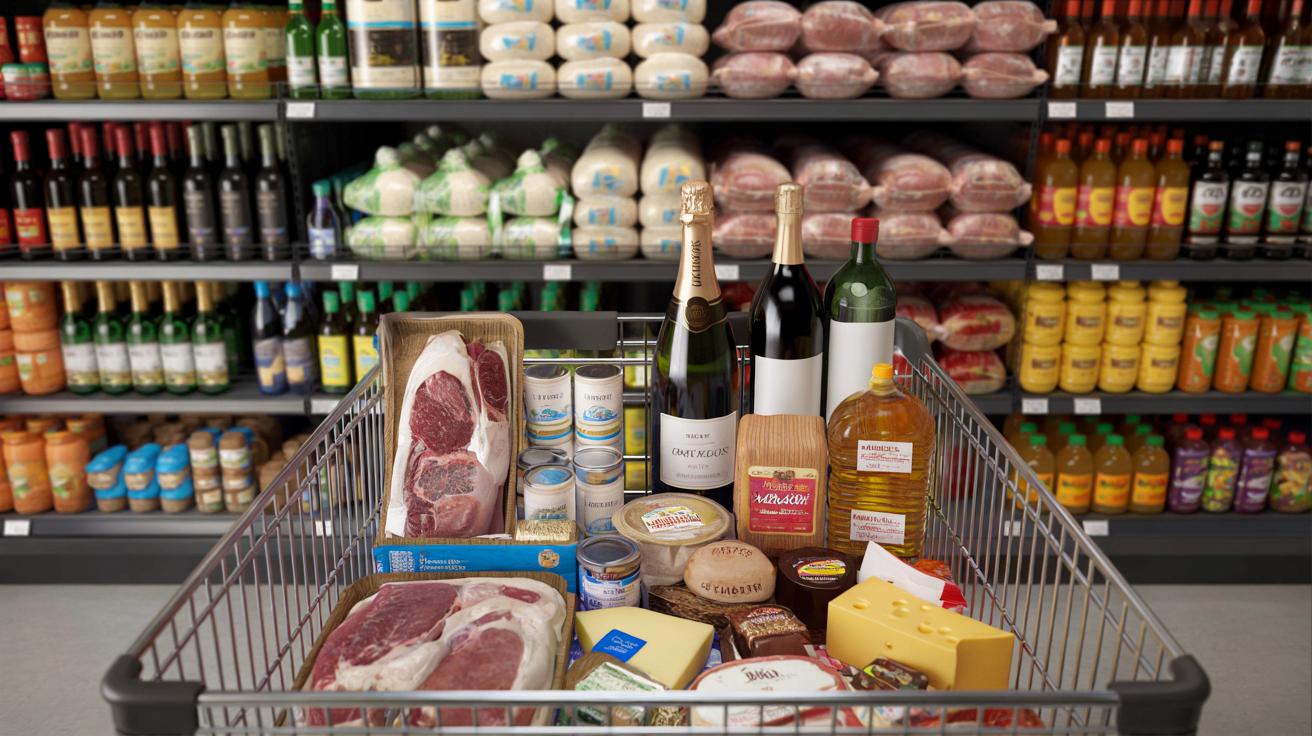
As Europe signs a vast new trade pact with South America, your steak, wine, chocolate and olive oil may soon face fresh competition.
The EU–Mercosur agreement, negotiated for a quarter of a century, is no longer an abstract Brussels project. It is about to reshape what arrives on European supermarket shelves and what European producers can sell across the Atlantic. From beef quotas and cheap sugar to protected cheeses and Champagne, the list of foods affected is far longer than just “South American meat”.
What is the Mercosur deal and why does it matter for food?
Mercosur, short for “Southern Common Market”, brings together Brazil, Argentina, Paraguay, Uruguay and Bolivia. The EU has spent roughly 25 years trying to seal a trade accord with this bloc.
In January, a majority of EU member states backed the free trade agreement, despite opposition from France, Austria, Ireland, Poland and Hungary. The European Commission presents it as a strategic win: a market of around 780 million consumers and a combined economic weight that ranks fifth worldwide.
The deal aims to phase out more than 90% of customs duties between the two regions, including on many everyday food products.
For agriculture, that shift is huge. Tariffs shape which foods are profitable to import or export. Once they fall, volumes and prices can move quickly, and domestic producers feel the pressure first.
European farmers’ anger: more than just symbolism
French farmers have been particularly vocal, staging protests and warning of unfair competition. Several opinion polls in France show strong public scepticism toward the agreement. One Elabe survey for BFMTV reported around 70% of respondents opposing the trade deal.
Behind the headlines about “Brazilian beef” lie concrete numbers and detailed product lists. The accord touches meat, dairy, sugar, rice, honey, wines and a long catalogue of products with geographical indications.
Key European food sectors opening up under Mercosur
The EU is not just opening its own market. It aims to boost its food exports into South America as well. A slow removal of more than 90% of customs duties is designed to benefit several high-value European sectors.
Wine and spirits: viticulture goes on the offensive
European winemakers are among those set to gain from easier access to Mercosur markets. Lower tariffs should make bottles from major wine regions more competitive in Brazil and Argentina, where imported wine can be costly.
➡️ Fruit recall at Intermarché, Grand Frais, Fresh and others over pesticide limit breach
➡️ This simple trick finally stops your caramel from burning or crystallising
➡️ The jury still can’t believe it: these two French brothers just won the pastry world championship
➡️ “These are not miracle teas and infusions”: Dr Cohen urges caution with these 4 products
➡️ Nationwide recall in France after goat’s cheese found contaminated with harmful bacteria
➡️ Stuck shell, torn whites: that’s ancient history with the spoon trick for peeling hard-boiled eggs
➡️ Nationwide recall in France over sheep’s cheese contaminated with listeria
➡️ Your leftover raclette deserves better than a box forgotten at the back of the fridge
Spirits are in a similar position. Protected names such as Champagne or specific regional liqueurs will have stronger legal backing, helping European brands distinguish themselves from local imitations.
Wine, Champagne and other European alcohols will enjoy better market access and stronger name protection across Mercosur countries.
Olive oil, dairy, chocolate: southern Europe’s big stakes
Producers of olive oil, especially in Spain and Italy, are also expected to benefit from reduced tariffs. Those countries already dominate the global olive oil trade and see South America as a growing middle-class market.
Dairy is another major sector. The agreement covers:
- Milk and cream
- Milk powder
- Butter and specialty butters
- Cheese exports
- Chocolate and confectionery made in Europe
Companies selling milk powder, cheese ingredients and chocolate bars hope that lower import duties will strengthen their position in South American supermarket aisles.
Protected names: what happens to Roquefort, Champagne and more?
A central feature of the accord is the recognition of European geographical indications — those famous labels like AOP (Protected Designation of Origin) and IGP (Protected Geographical Indication).
The deal extends legal protection for dozens of European cheeses, wines, spirits, meats and specialty foods across Mercosur markets.
Among the products covered:
| Category | Examples of protected products |
|---|---|
| Cheeses | Comté, Gruyère, Roquefort and other regional varieties |
| Wines & spirits | Chablis, Champagne, Guadeloupe rum and numerous named appellations |
| Dairy & fats | Charentes-Poitou butter and other traditional butters |
| Seafood | Marennes-Oléron oysters |
| Fruit & crops | Agen prunes, Camargue rice |
| Meats | Charolles beef, Bayonne ham, among others |
In practice, this means a producer in Brazil could not market a blue cheese as “Roquefort” or a sparkling wine as “Champagne” unless it complies with EU rules and originates from the designated region.
South American agricultural quotas heading into the EU
The most sensitive chapter for European farmers is the creation of new import quotas for South American agricultural goods. These quotas allow defined volumes into the EU at low or zero tariffs.
The agreement opens the EU market to tens of thousands of tonnes of South American meat, sugar, rice and honey every year.
Current figures discussed for annual quotas include:
- 99,000 tonnes of beef
- 180,000 tonnes of poultry
- 180,000 tonnes of sugar
- 60,000 tonnes of rice
- 45,000 tonnes of honey
These are not small numbers. They represent real competition for European cattle farmers, poultry producers, sugar beet growers, rice growers and professional beekeepers.
Why meat imports trigger the fiercest backlash
Beef and poultry sit at the heart of the political storm. European farmers argue that South American producers often operate with lower costs, larger industrial farms and, in some cases, weaker environmental or animal welfare rules.
This raises fears of “social and environmental dumping” — goods produced under looser standards undercutting stricter EU producers. The Commission, for its part, insists that imported meat will still have to comply with European sanitary regulations.
What this could mean for shoppers and food prices
For consumers, the agreement could bring more choice and potentially lower prices for some products. Cheaper beef, poultry, sugar or rice imports can put downward pressure on retail prices, at least in the medium term.
At the same time, if European farmers see their income drop, public pressure for extra subsidies may grow. That debate could reshape where taxpayer money goes within the EU’s agricultural policy.
On the export side, successful sales of European wines, cheeses and chocolate to Mercosur countries can support jobs in those industries and in port logistics, shipping and packaging.
Key terms worth understanding
The debate around Mercosur is full of acronyms that often go unexplained. Two of the most common are AOP and IGP, both linked to food labels.
An AOP (Protected Designation of Origin) covers products whose production, processing and preparation all take place in a defined geographical area, following a recognised method. Roquefort, for example, must come from a specific part of France and be made under strict conditions.
An IGP (Protected Geographical Indication) is slightly looser. At least one stage of production, processing or preparation must happen in the given region, and the product has a reputation linked to that area. Bayonne ham is a classic illustration.
Possible scenarios for the next few years
If South American exporters quickly fill their new quotas in beef, poultry and sugar, European producers in these sectors may face a strong price squeeze, particularly in countries where farm sizes are small and production costs are high.
You could see a wave of restructuring: consolidation of farms, diversification into higher-value labels, or a stronger push toward organic and local sales channels where imported mass-market products compete less directly.
On the other side of the Atlantic, small and medium-sized South American producers may struggle to take full advantage if exporting remains dominated by large agribusiness firms. The benefits of tariff cuts can be unevenly spread within Mercosur countries as well.
How consumers can react through their food choices
Shoppers who want to support local agriculture still have tools at hand. Labels indicating origin, AOP/IGP stamps, and farmers’ markets make it easier to identify products grown or raised nearby.
Some may choose a mixed basket: imported seasonal fruit or coffee from Latin America, coupled with European cheeses, local meat and regional wines or beers. Others might use the renewed debate around Mercosur as an occasion to ask supermarkets for clearer origin labelling and more detailed information on production standards.
Whatever your stance on trade liberalisation, the Mercosur deal shows how distant negotiations can end up right in your fridge and on your plate, shaping what you eat, how much you pay, and which farmers stay in business on both sides of the Atlantic.