<strong>Chapo.
The hard-boiled eggs are perfect, the timing is spot on, and then the peeling step ruins everything… or does it?
Home cooks have long accepted that peeling hard-boiled eggs means sacrificing a chunk of white along the way. A surprisingly simple spoon trick is now challenging that belief, turning the dreaded peeling stage into a clean, almost satisfying gesture.
Why some eggs peel cleanly and others fall apart
If you feel your eggs are out to get you, there is a reason. It mostly comes down to freshness.
The fresher the egg, the tighter the bond between the white and the thin inner membrane that lines the shell. That bond is what causes so much damage when you try to peel.
As eggs age, the pH inside rises and a small air pocket grows. The membrane gradually releases from the white, and peeling gets much easier.
Fresh eggs cling to their shells; slightly older ones let go far more willingly.
The problem is that many people buy very fresh eggs and want them hard-boiled the same day, especially for salads, packed lunches or kids’ snacks. Waiting a week for “better” peeling is hardly appealing when you just want something quick.
That is where the spoon at the bottom of the pan steps in: it changes how the egg cooks in the shell, so you can use fresh eggs without shredding them.
The spoon at the bottom of the pan trick
The idea looks almost too minimal: place a metal tablespoon in the pan, add your eggs, cover with water, and cook as usual.
Ukrainian chef Anatolii Dobrovolskyi popularised the hack on social media, filming himself sliding a spoon under the eggs before bringing the water to a boil. The cooking time stays classic: bring to the boil from cold water, then simmer for 10–12 minutes.
➡️ Paris boils over: the world’s most Michelin-starred female chef opens a dream restaurant
➡️ Here Are The Food Products Hit By The Mercosur Trade Deal
➡️ Why you should always flip your sardine tins in your cupboard
➡️ One ordinary ingredient is all you need for a puffy, restaurant-style omelette
➡️ Why chefs swear by clarified butter to elevate their dishes – and how to make it
➡️ Have you ever tried cloud eggs? This light way to cook them
➡️ “These are not miracle teas and infusions”: Dr Cohen urges caution with these 4 products
➡️ No, I never choose the same onion for every dish, this one transforms my salads
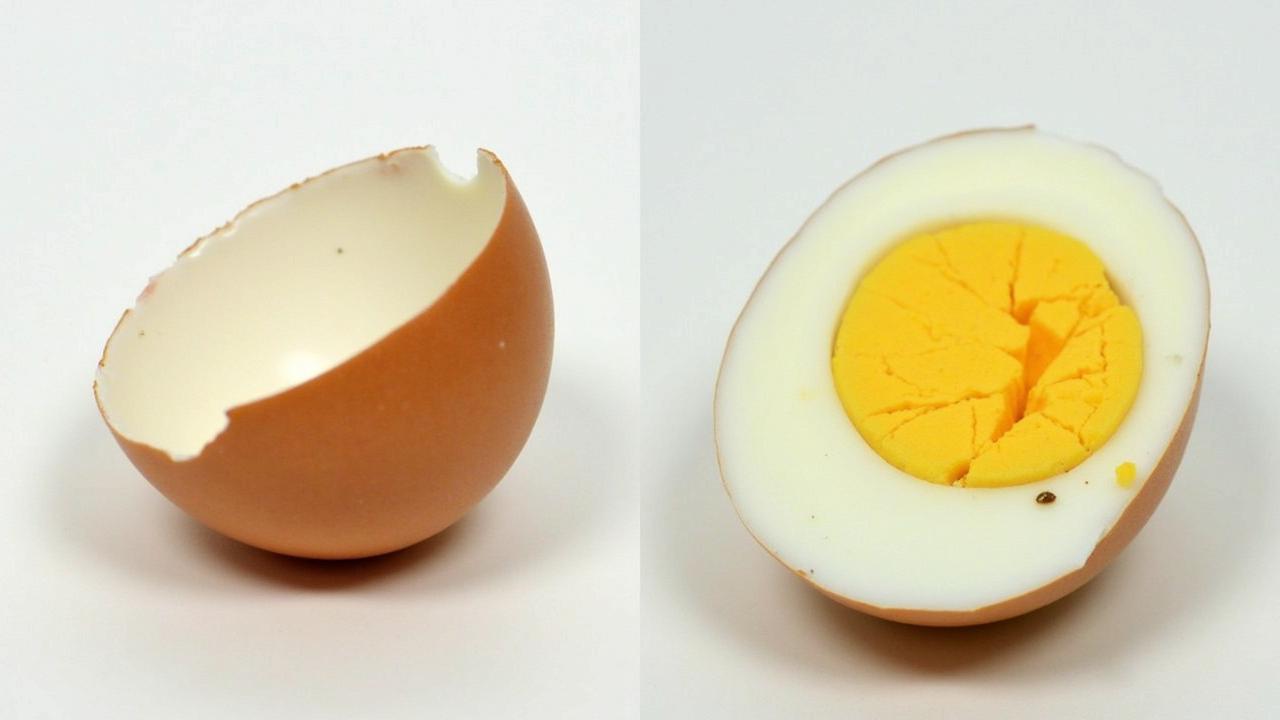
When the eggs are cooled and ready to peel, something unexpected happens. The shell comes away in large, generous pieces. The white stays smooth, with barely any craters.
A simple spoon in the pan nudges the eggs just enough so the whites do not weld themselves to the shell.
What the spoon actually does during cooking
There is no magic, no special metal and no chemical reaction involved. The spoon changes movement.
As the water boils, the eggs shift and bump around gently, hitting the curved surface of the spoon. These repeated, tiny impacts create micro-vibrations.
Because the eggs keep moving rather than sitting completely still, the proteins in the whites do not coagulate directly and uniformly against the shell.
That tiny gap, created over and over again during cooking, means the white adheres less firmly to the inner membrane.
The eggs stay just restless enough in the pan to stop the white from gluing itself to the shell.
The result after cooling: the bond between shell, membrane and white is weaker, even if the egg itself was very fresh to begin with.
How to use the spoon method step by step
For anyone who wants to test it during the next batch of hard-boiled eggs, the process is straightforward.
- Place a metal tablespoon at the bottom of a saucepan.
- Gently add the eggs on and around the spoon in a single layer.
- Cover with cold water by about 2–3 cm.
- Bring to a boil over medium-high heat.
- Once boiling, lower the heat and simmer for 10–12 minutes.
- Transfer the eggs immediately to very cold water or an ice bath.
- Tap, roll, peel: the shell should come off in big sheets.
Cooling the eggs quickly matters too. Cold water shocks the shell and helps separate the membrane a little bit more. Combined with the spoon’s micro-movements, the effect is noticeable.
Does it work with all kinds of eggs?
The spoon technique appears helpful with standard hen eggs, both from the supermarket and from backyard hens.
Extremely fresh farm eggs, collected the same morning, are usually the worst for peeling. These are the ones where the spoon trick can make the most dramatic difference, especially if you also give them a long cold bath after cooking.
With eggs that are already a week or so old, peeling tends to be easy anyway. In those cases, the spoon is more of an extra safety net than a game changer.
Other variables that influence peeling
Peeling is never just about one factor. A few other elements weigh in:
| Factor | Effect on peeling |
|---|---|
| Cooking time | Overcooked eggs get rubbery whites that tear more easily. |
| Water temperature | Starting from cold and heating gently cooks the egg more evenly. |
| Cooling method | An ice bath makes shells contract and detach a little from the white. |
| Cracking before peeling | Rolling the egg to crack all around helps water slip under the shell. |
The famous baking soda or vinegar tricks do not always deliver. They slightly change the water’s pH, but results vary and can affect flavour. The spoon leaves the taste untouched.
Tips for peeling without wrecking the white
Once your eggs are cooked with the spoon and cooled, technique at the sink still matters.
Tap the egg on the counter to crack the shell on both ends, then roll it gently so it becomes finely networked with cracks.
Start peeling from the wider end, where the air pocket sits. You will often find a small empty space between shell and white that gives you a better grip.
Peel under a thin stream of cold water. The water slides between the layers and helps lift the membrane without ripping the white.
Good peeling is half preparation, half hand movement: treat the egg like something fragile, not like a stubborn jar lid.
When perfect hard-boiled eggs actually matter
For a quick solo snack, a few missing bits of white do not really matter. In other situations, appearance counts.
Think of devilled eggs on a holiday table, ramen bowls finished with glossy egg halves or a composed salad where jagged edges look messy.
In professional kitchens, trays of perfectly peeled eggs save time and reduce waste. Losing 10–15% of each egg in torn whites quickly adds up in cost and frustration.
For parents preparing lunchboxes or snack plates, neat eggs can make the difference between something kids want to eat and something they reject because it “looks weird”.
Safety, storage and a few useful definitions
When playing with eggs, a small refresher on terminology and safety does not hurt.
Hard-boiled usually means a fully set yolk, cooked for around 10–12 minutes from boiling. Soft-boiled keeps a runny or jammy centre, often between 6 and 8 minutes.
Peel only what you will use within the next few days. Unpeeled hard-boiled eggs keep better in the fridge, usually up to a week. Peeled ones should be stored in a closed container and eaten within three to four days.
If an egg smells sulphurous or feels oddly slimy once peeled, throw it away. Taste is never worth taking risks with foodborne bacteria.
What this trick changes for everyday cooking
The spoon method will not transform a basic hard-boiled egg into fine dining, but it does remove one common irritation from weekday cooking.
Being able to peel eggs without drama broadens their use: quick protein for salads, sandwiches, grain bowls, picnic platters or on toast with a drizzle of olive oil and chilli flakes.
It also reduces waste. Each cleanly peeled egg keeps its full size, which matters if you are counting portions or using egg halves as a base for fillings.
And it reminds many home cooks of a reassuring message: the kitchen is often ruled less by expensive gear than by small, clever adjustments. In this case, a basic spoon is enough to turn a fragile operation into a simple one.